

Contents
Innovation through research and development (R&D) can be a significant cost for businesses. That’s why Ireland’s R&D Corporation Tax Credit supports companies investing in innovation. If your company is creating, improving, or solving something technologically challenging, you could be eligible to claim back a proportion of your qualifying costs.
This guide covers everything you need to know about R&D Tax Credits, from eligibility and qualifying costs to claim values, deadlines, and how the claims process works.
R&D Tax Credits at a Glance
Short on time? Here’s a quick overview of the key things you need to know about R&D Tax Credits before exploring the guide in more detail.
Key points:
- Who can claim? Companies that are within the charge to Corporation Tax in Ireland may be eligible to claim, regardless of industry or company size, provided they carry out qualifying R&D. Projects don’t need to be commercially successful to qualify.
- What counts as R&D? Work that aims to advance science or technology by overcoming scientific or technological uncertainty may qualify. This could include developing software, improving manufacturing processes, engineering solutions, or creating new products.
- What costs can you claim? Qualifying expenditure may include staff costs, consumables, subcontracted R&D (subject to applicable conditions and limits), certain agency or externally provided staff costs, and qualifying expenditure on plant, machinery, buildings or structures.
- What do you receive? The R&D Corporation Tax Credit is generally available in three annual instalments. For each instalment, companies can choose to receive a payment from Revenue, offset the amount against tax liabilities, or use a combination of both.
- What is the current rate? The R&D Tax Credit rate is 30% for accounting periods commencing on or after 1 January 2024 and generally ending before 31 December 2026. A 35% rate applies where the specified return date falls on or after 23 September 2027, which Revenue states will generally apply to accounting periods ending on 31 December 2026 or later.
- How far back can you claim? An R&D Tax Credit claim must generally be made within 12 months of the end of the accounting period in which the qualifying expenditure was incurred.
- First time claiming? First-time claimants and companies that haven’t made an R&D Tax Credit claim in any of the previous three accounting periods may need to submit a pre-filing notification to Revenue. For accounting periods commencing on or after 1 January 2024, this must be submitted through MyEnquiries via ROS at least 90 days before the claim is made.
- Why claim? It can improve cash flow, reduce tax liabilities, fund future innovation, and lower the financial risk of R&D.
- Common mistakes: Claiming non-qualifying projects, overclaiming expenditure, missing eligible costs, or providing insufficient evidence can increase the risk of a Revenue enquiry.
- Do you need a specialist? Businesses can prepare and submit claims themselves or through their accountant, but many choose to work with an R&D Tax Credit specialist to help ensure their claim is accurate, compliant, and fully optimised.
Bottom line: If your business has invested in solving scientific or technological challenges or developing new or improved products, services, or processes, it’s worth assessing your eligibility. Even unsuccessful projects may qualify, and the R&D Corporation Tax Credit can provide valuable financial support for continued innovation.
What is the R&D Corporation Tax Credit?
Ireland’s R&D Corporation Tax Credit was introduced in 2004 to encourage innovation and support economic growth. Since then, billions of euros have been claimed by businesses developing new products, improving existing processes, and overcoming scientific or technological challenges.
Depending on your company’s circumstances, a successful R&D claim could significantly reduce your Corporation Tax bill or provide a payable tax credit, helping you offset some of the costs involved in research and development.
How does the R&D Tax Credit work?
Bringing new business ideas to life often requires significant investment. To help offset some of those costs, eligible businesses can claim R&D tax relief on qualifying research and development activities.
When your company undertakes qualifying R&D work, certain project costs can be included within an R&D claim. Once submitted to Revenue, those costs may generate an R&D Corporation Tax Credit, which can be paid to the company, offset against tax liabilities, or divided between the two.
While every claim is different, the process typically involves:
- Identifying qualifying R&D projects
- Calculating eligible expenditure
- Preparing supporting technical and financial information
- Submitting an R&D claim to Revenue through Form CT1 on ROS
- Receiving the credit as a payment, tax offset, or a combination of both
The amount your business receives will depend on factors such as your qualifying expenditure, the accounting period being claimed, and the R&D Tax Credit rate that applies to your claim.
What You Actually Receive
One of the most common questions businesses ask is whether R&D Tax Credits result in a cash payment.
Under the current Irish regime, the credit is generally available in three annual instalments. For each instalment, a company can choose to:
- Receive a payment from Revenue
- Offset the amount against its tax liabilities
- Divide the amount between a payment and a tax offset
Whichever option applies, the aim is ultimately the same: to reward businesses for investing in innovation and help reduce the financial burden of research and development activities.
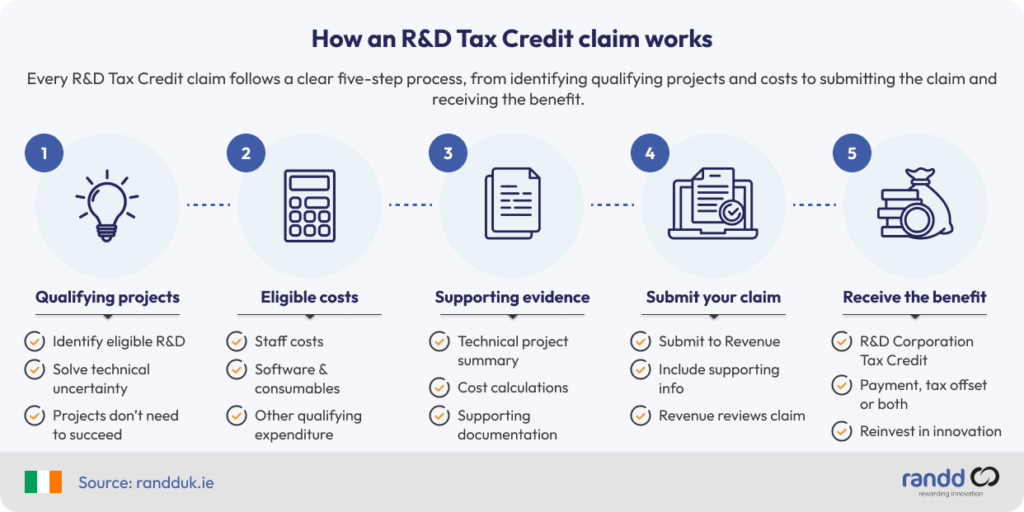
Figure 1: The five key stages of an R&D Tax Credit claim, from identifying qualifying R&D to receiving the benefit.
Latest Irish R&D Tax Credit Changes
Ireland’s R&D Tax Credit regime has changed substantially in recent years.
For accounting periods commencing on or after 1 January 2023, claims are generally made under the R&D Corporation Tax Credit provisions in sections 766C and 766D of the Taxes Consolidation Act 1997.
The credit rate increased from 25% to 30% for accounting periods commencing on or after 1 January 2024.
Following Finance Act 2025, a 35% rate applies where the specified return date for the accounting period is on or after 23 September 2027. Revenue states that this will generally apply to accounting periods ending on 31 December 2026 or later.
The amount potentially available in the first instalment has also increased:
- For accounting periods commencing on or after 1 January 2025 and generally ending before 31 December 2026, the relevant threshold is €75,000.
- For periods generally ending on 31 December 2026 or later, the threshold is €87,500.
New pre-filing notification requirements also apply to certain claimants, as explained below.
Is it still worth claiming?
Absolutely. Although the Irish R&D Tax Credit regime has changed in recent years, it remains one of the most valuable forms of government support available to innovative Irish businesses.
For companies investing significant time, expertise, and resources into developing products, improving processes, or solving technical challenges, the financial benefit can still be substantial.
Many businesses are surprised to discover that projects they consider part of their day-to-day operations may qualify for R&D Tax Credits. That’s why it’s often worth exploring your eligibility, even if you’re unsure whether your activities meet the criteria.
R&D Tax Credit Eligibility
One of the biggest misconceptions about R&D Tax Credits is that they’re only available to businesses carrying out groundbreaking scientific research.
In reality, R&D Tax Credit eligibility is broader than many companies realise. If your business is developing or improving a product, process, or service and has needed to overcome scientific or technological uncertainty, there may be qualifying R&D taking place.
Importantly, a project doesn’t need to be commercially successful to qualify – it’s the work involved in attempting to overcome the uncertainty that matters.
Who Qualifies?
Companies of all sizes that are within the charge to Corporation Tax in Ireland may qualify for R&D Tax Relief. R&D Tax Credits aren’t limited to laboratories or technology companies, as businesses across a wide range of sectors may qualify. Ultimately, eligibility depends on the nature of the work undertaken rather than the industry you operate in. Some of the sectors we regularly support include:
- Software & IT
- Manufacturing
- Construction
- Engineering
- Food & Drink
- Agriculture & Farming
- Marine & Aviation
Ultimately, eligibility isn’t determined by your industry. What matters is whether your business is attempting to achieve an advance in science or technology while overcoming technical or scientific uncertainty.
If you’re unsure whether your business qualifies, our detailed guide explaining who is eligible for R&D Tax Credits explores the criteria in more detail.
What Counts as R&D?
For tax purposes, Revenue defines research and development as work that seeks to achieve an advance in science or technology by overcoming scientific or technological uncertainty. Importantly, the advance must contribute to knowledge or capability within the relevant field of science or technology, rather than simply representing an improvement that is new only to your business.
That may sound complex, but in practice it often comes down to whether your business is trying to solve a technical challenge where the solution isn’t readily available or obvious from the outset.
Qualifying activities may include:
- Developing new products, processes, or services
- Improving the performance, functionality, or efficiency of existing products
- Creating bespoke software or technical systems
- Designing new manufacturing techniques
- Testing and evaluating potential solutions
- Building prototypes and carrying out technical trials
What Projects Qualify for R&D Tax Credits?
Qualifying projects can be found in businesses of all sizes and across many different sectors.
Examples of projects that may qualify include:
- Developing innovative software functionality
- Creating more efficient manufacturing processes
- Designing specialist engineering solutions
- Reformulating food and drink products
- Improving agricultural technologies
- Developing new materials or production methods
Importantly, a project doesn’t need to be commercially successful to qualify.
Even if the project fails, is abandoned, or doesn’t achieve its intended outcome, the work could still qualify as long as genuine scientific or technological uncertainty existed throughout development.
Does Your Business Qualify?
Perhaps the easiest way to assess whether your business may qualify is to look at the challenges your team has faced during development.
If you’ve invested time, expertise, and resources into solving technical problems, improving existing technologies, or creating something that didn’t have an obvious solution from the outset, there’s a strong possibility that qualifying R&D activities have taken place.
Since every project is different, eligibility isn’t always straightforward. If you’re unsure whether your project meets Revenue’s criteria, learn more about who is eligible for R&D Tax Credits before making a claim.
Alternatively, speaking with an R&D tax specialist can help you understand whether your activities qualify and ensure you’re not overlooking valuable claim opportunities.
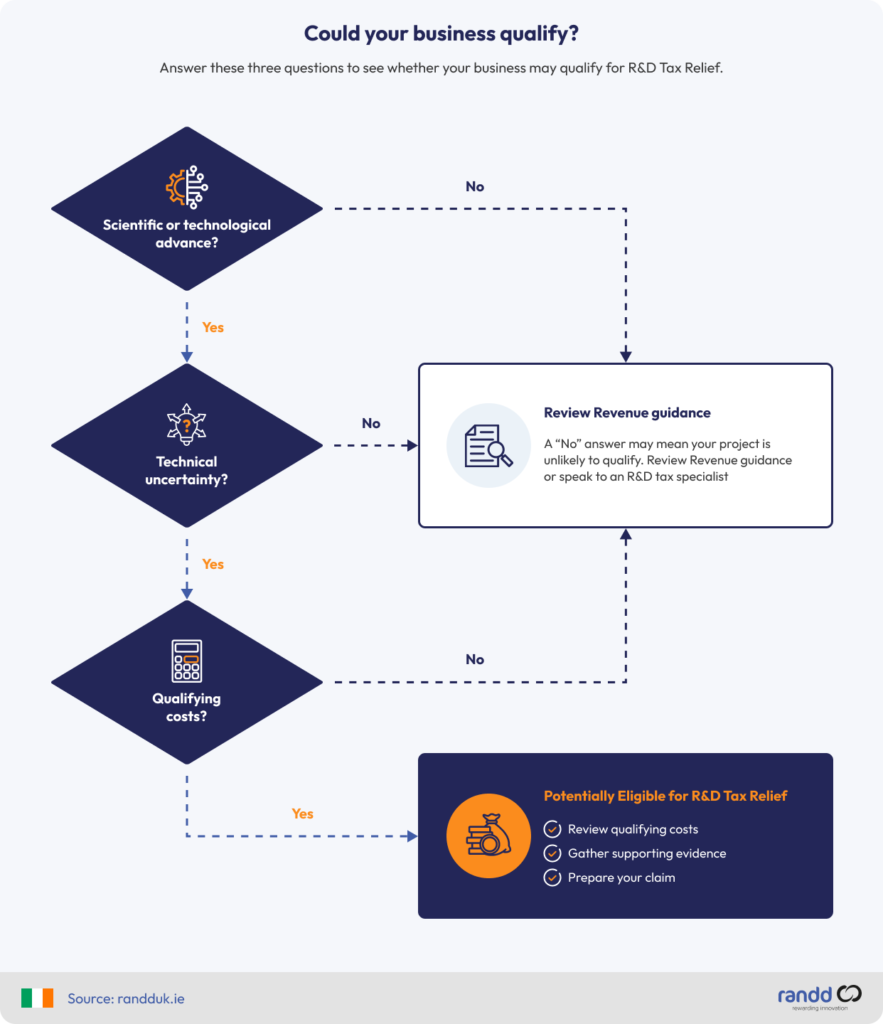
Figure 2: The key questions that can help determine whether your business may qualify for R&D Tax Credits in Ireland.
What Costs Can Be Claimed?
Expenditure must be incurred wholly and exclusively in carrying on qualifying R&D activities and must satisfy the relevant statutory and Revenue requirements. Where a cost relates partly to R&D and partly to other activities, an appropriate and supportable allocation may be required.
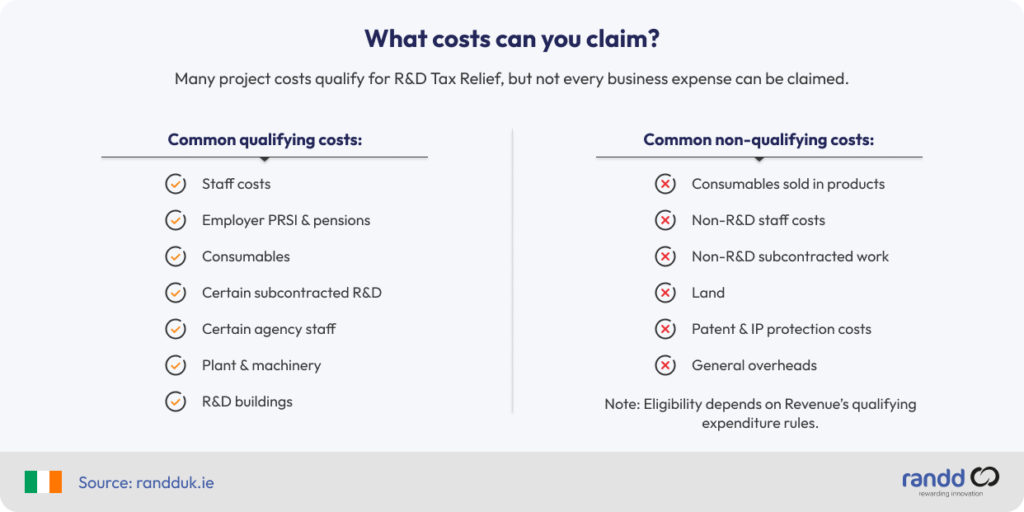
Figure 3: A comparison of common qualifying and non-qualifying R&D Tax Credit costs in Ireland.
Qualifying R&D Expenditure
Depending on the nature of your project, qualifying R&D expenditure may include:
- Cost of staff directly involved in R&D work, including wages and salaries, employer PRSI contributions, and pension contributions
- Consumable items used in the R&D process, such as fuel, materials, power, and water
- Subcontracted R&D expenditure, subject to the applicable conditions and limits. The qualifying amount is generally limited to the greater of €100,000 or 15% of the company’s qualifying in-house R&D expenditure
- Certain agency or externally provided staff costs, where the individuals carry out qualifying R&D activities on behalf of the company
- Plant and machinery used for qualifying R&D, subject to the relevant capital expenditure rules
- Buildings or structures used for qualifying R&D, where the relevant conditions are met
Not every cost associated with an R&D project will necessarily qualify. The expenditure must meet Revenue’s requirements and be attributable to qualifying R&D activities.
Some costs are not eligible for R&D Tax Relief, including:
- Consumable items that are sold, or incorporated into products for sale
- Staff costs unrelated to qualifying R&D, such as redundancy payments, administrative staff, payroll, or routine maintenance work
- Subcontracted activities that do not directly contribute to qualifying R&D, including routine testing, analysis, or consultancy outside the scope of the R&D project
- Capital expenditure on land
- Costs associated with patents, trademarks, or intellectual property protection
- General overheads, such as rent, rates, insurance, marketing, and distribution costs, where they are not directly attributable to qualifying R&D activities
Since the rules can vary depending on the accounting period and the nature of the expenditure, it’s important to ensure costs are assessed correctly before being included within an R&D claim.
Receiving a grant does not automatically prevent an R&D Tax Credit claim. However, grants can affect how qualifying expenditure is calculated, so their impact should be assessed carefully.
How Are R&D Tax Credits Paid?
R&D Corporation Tax Credits are generally available in three annual instalments.
For each instalment, a company can choose to have the amount:
- paid by Revenue
- treated as an overpayment and offset against tax liabilities
- divided between payment and offset
The amount available in the first instalment depends on the relevant accounting period and the total value of the credit claimed.
For accounting periods commencing on or after 1 January 2025 and generally ending before 31 December 2026, claims of up to €75,000 may generally be available in the first instalment.
For accounting periods generally ending on 31 December 2026 or later, the corresponding threshold is €87,500.
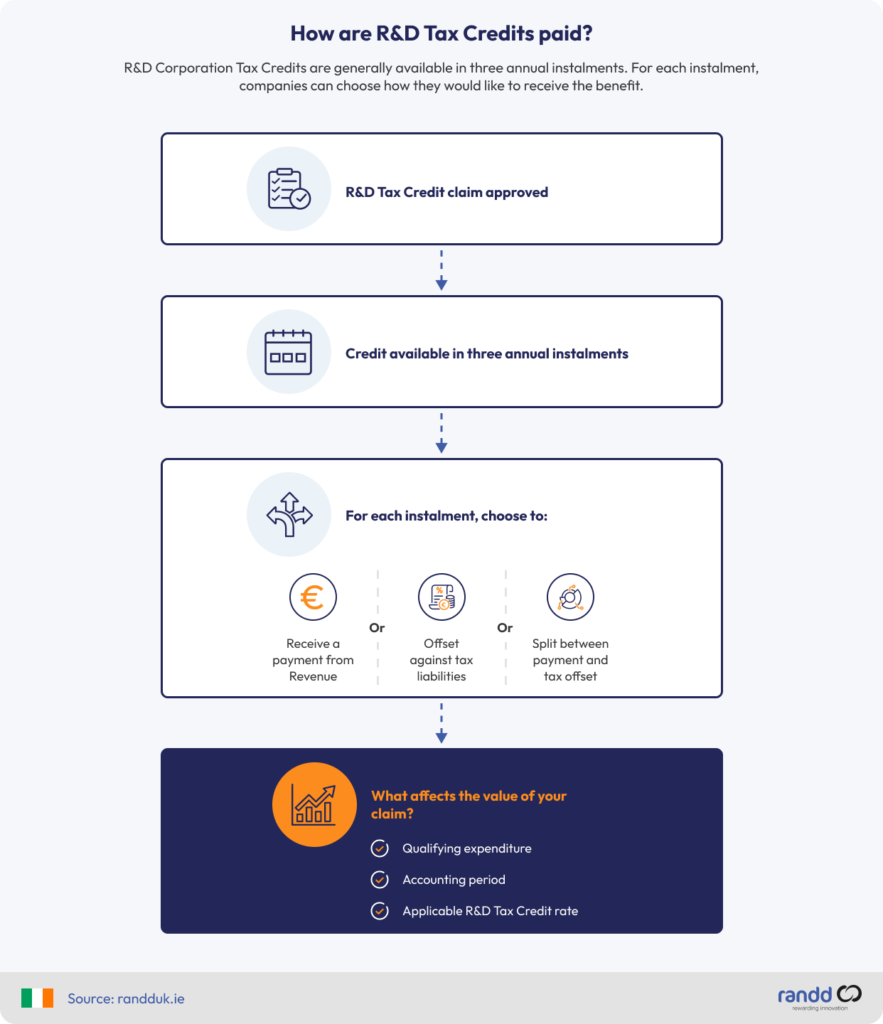
Figure 4: How R&D Tax Credits are paid in Ireland, including the available payment and tax offset options.
How Much Are R&D Tax Credits Worth?
One of the first questions businesses ask is how much they could potentially receive from an R&D claim.
The answer depends on several factors, including:
- Your qualifying R&D expenditure
- The accounting period being claimed
- The R&D Tax Credit rate applying to that accounting period
- Whether any limits apply to particular categories of expenditure
- The impact of any grants or other funding received
While every claim is different, R&D Tax Relief can provide a significant financial benefit for businesses investing in innovation.
R&D Tax Credit Rates
The value of an R&D claim depends primarily on the amount of qualifying expenditure and the credit rate applying to the relevant accounting period.
| Accounting period | R&D Tax Credit rate |
| Accounting periods beginning before 1 January 2024 | 25% |
| Accounting periods commencing on or after 1 January 2024 and generally ending before 31 December 2026 | 30% |
| Accounting periods generally ending on 31 December 2026 or later subject to the specified return date rules | 35% |
Table 1: R&D Tax Credit rates in Ireland by accounting period.
Note: The 35% rate technically applies where the specified return date falls on or after 23 September 2027. Companies with non-calendar-year accounting periods should confirm which rate applies.
If you’re claiming for an earlier accounting period, previous R&D Tax Relief rates may apply.
How to Calculate R&D Tax Credits
If you’re looking for a quick estimate, our R&D Tax Credit Calculator can help you understand what your claim could be worth based on your company’s circumstances.
Calculating the value of an R&D claim isn’t always straightforward. The final amount will depend on your qualifying expenditure, the accounting period being claimed, the applicable credit rate, and any restrictions affecting particular costs.
As a starting point, businesses should identify all eligible R&D expenditure and calculate the total value of qualifying costs incurred during the accounting period. From there, the applicable rate and expenditure can be applied to estimate the potential value of the claim.
While a calculator provides a useful indication, every claim is different. For a more accurate assessment, it’s worth speaking to an R&D Tax Credit specialist who can review your qualifying projects and expenditure.
R&D Tax Credit Deadlines & Timelines
Understanding the deadlines involved in the R&D claim process is important, as claims submitted outside the allowable time limits may no longer be eligible for relief.
Do you need to notify Revenue before making a claim?
First-time claimants and companies that haven’t made an R&D Tax Credit claim in any of the previous three accounting periods may need to notify Revenue in advance by submitting a pre-filing notification form. For accounting periods commencing on or after 1 January 2024, the form must be submitted through MyEnquiries via ROS at least 90 days before the R&D Tax Credit claim is made, so it’s important to check whether the requirement applies well in advance of filing.
How often can you claim R&D Tax Credits?
Businesses typically make one R&D claim for each accounting period, usually as part of their Corporation Tax return. If necessary, claims can generally be amended or resubmitted before the relevant Revenue deadline.
It’s also possible to claim for a previous accounting period, provided the claim falls within Revenue’s time limits.
An R&D Tax Credit claim must generally be made within 12 months of the end of the accounting period in which the qualifying expenditure was incurred. Companies that have overlooked qualifying projects should therefore review their position as soon as possible.
How long does it take to receive R&D Tax Credits?
The complexity of a claim and current Revenue workloads can affect processing times.
Processing times can vary depending on when the Form CT1 is filed, the information provided, and whether Revenue needs to carry out additional checks or request further information.
More complex claims, or those selected for further review, may take longer.
The Benefits of R&D Tax Credits
R&D Tax Credits offer far more than a simple tax saving.
By helping businesses recover a proportion of their research and development costs, the scheme provides additional resources that can be reinvested into future growth and innovation.
Adding Value to Your Business
R&D Tax Relief can help businesses:
- Improve cash flow
- Invest in future innovation
- Recruit and retain skilled employees
- Purchase equipment and technology
- Bring new products and services to market more quickly
- Reduce the financial risks associated with research and development
For many businesses, R&D Tax Credits provide accessible funding without the need for loans, grants, and external investment.
Avoiding Common Mistakes & Revenue Enquiries
Preparing an R&D claim can be complex, even if you’ve done so before, particularly as the rules and requirements continue to evolve.
Common mistakes include:
- Including non-qualifying projects
- Overclaiming expenditure
- Failing to provide sufficient technical evidence
- Misinterpreting Revenue guidance
- Missing eligible costs that could increase the value of the claim
Errors like the above can increase the likelihood of Revenue requesting additional information or opening an enquiry into a claim, so understanding the common pitfalls can help reduce risk and improve the quality of your claim.
Taking the time to properly assess projects, document technical challenges, and calculate qualifying expenditure can help ensure claims are accurate, compliant, and fully supported.
Working with an experienced R&D tax adviser can also provide additional confidence that your claim is robust, accurate, and aligned with Revenue requirements.
How to Claim R&D Tax Credits
A successful R&D claim relies on more than simply identifying qualifying projects. Businesses must also provide supporting information that demonstrates why the work qualifies and how eligible expenditure has been calculated.
What Documentation Do You Need to Claim?
The exact requirements will vary depending on your project and the industry you work in, but supporting documentation often includes:
- Project descriptions and technical reports
- Details of the scientific or technological challenges faced
- Financial records and cost breakdowns
- Payroll information
- Contractor and supplier invoices
- Supporting calculations and working papers
Maintaining accurate records throughout a project can make the claims process significantly easier and help support your position if Revenue requests further information.
Can you claim without a professional?
Yes, businesses are legally able to prepare and submit R&D claims themselves, or through their accountant, provided they have a clear understanding of the eligibility criteria and scheme requirements.
However, the legislation can be complex, particularly where projects involve multiple activities, subcontractors, or significant expenditure.
When to use a Specialist
Many businesses choose to work with an R&D Tax Credit specialist when they want additional confidence that their claim is accurate, compliant, and fully optimised.
A specialist can help identify qualifying activities, calculate eligible expenditure, prepare supporting technical documentation, and manage the submission process on your behalf.
At randd, our dedicated team of R&D specialists has helped businesses across a wide range of industries secure valuable tax relief while minimising risk and maximising claim value. As of 2026, our Revenue enquiry rate is 3%, compared with an industry average of 20%.
Ready to find out what your claim could be worth?
Use our R&D Tax Credit calculator for an instant estimate, or get in touch with one of our specialists for tailored advice on your eligibility and potential claim value.


Sign up to our Newsletter
Stay ahead with the latest R&D tax insights, funding updates, and innovation trends — straight to your inbox.